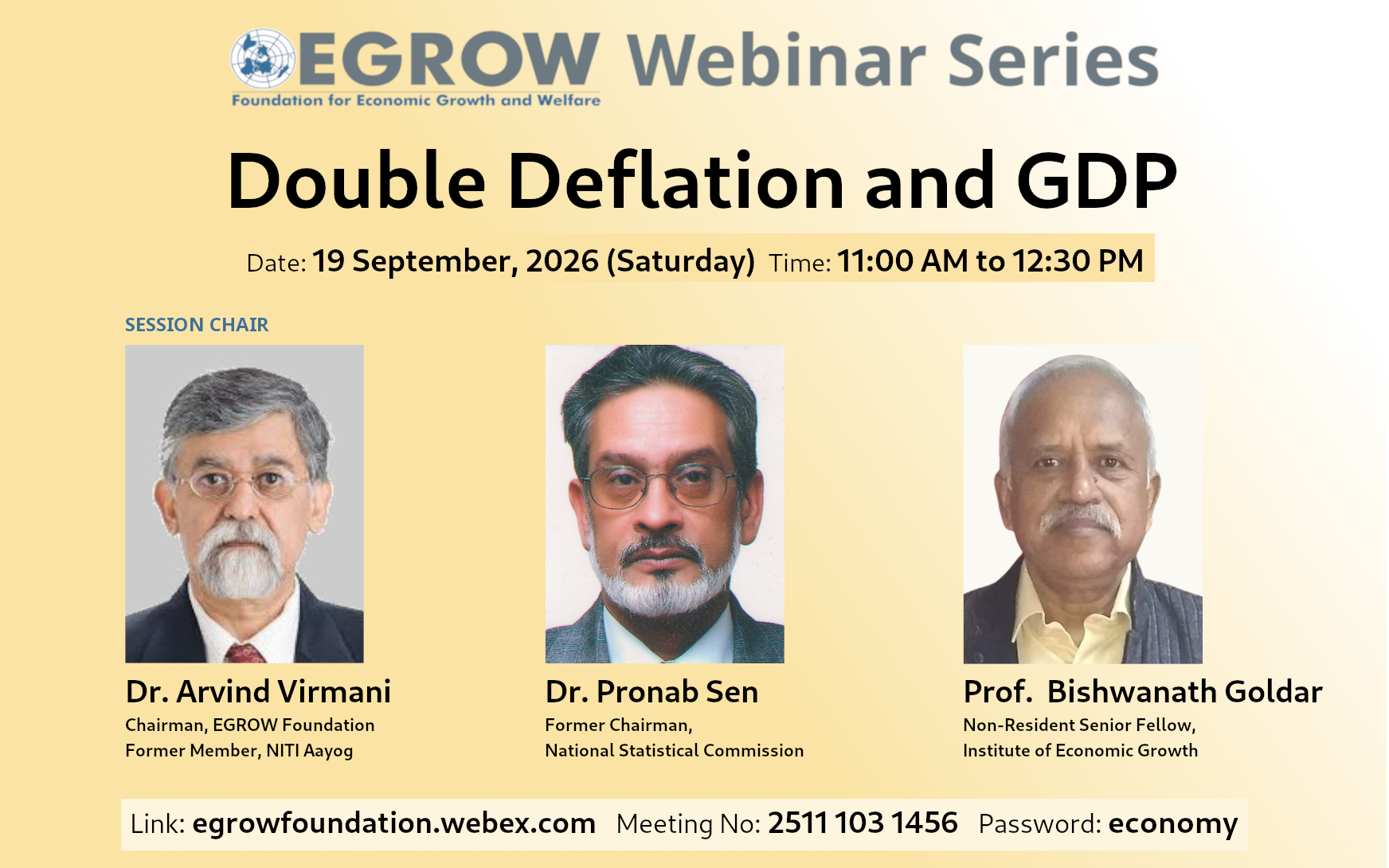
Double Deflation and GDP
Webinar Link
Meeting No: 2511 103 1456
Password: economy
Certificate of Participants
To recieve certificates, please register and attend
Abstract
Double deflation is an important method in national accounting for estimating gross value added in volume terms and strengthening the measurement of real Gross Domestic Product (GDP). Under single-indicator methods, an output- or input-based indicator is applied directly to value added. Double deflation, by contrast, separately estimates gross output and intermediate consumption in volume terms—using appropriate price or volume indicators—and derives real gross value added as the difference between them. By capturing changes in the relative prices of outputs and inputs, the approach can support more reliable analysis of real economic growth, productivity, and sectoral performance. The webinar will examine the conceptual foundations of double deflation, its data requirements and practical challenges, international practices, and its relevance for improving national accounts and economic policymaking.
Short Bios
Dr. Arvind Virmani
Arvind Virmani is Chairman of the Foundation for Economic Growth and Welfare (EGROW). He was member of NIti Aayog and President of the Forum For Strategic Initiatives (FSI, Delhi). He has been a Mentor (economic policy) to FICCI & a member of RBI Technical Advisory Committee on Monetary policy. He was earlier Executive Director, IMF and Chief Economic Advisor, Ministry of Finance and Principal Advisor, Planning Commission. During his tenure he advised on a host of economic policy reforms, through 100s of policy papers, notes and committees. He has served as Member, Telecom Regulatory Authority of India (TRAI) and as Director & Chief executive of the Indian Council for Research on International Economic Relations (ICRIER). He has published 35 journal articles and 20 book chapters and written over 50 other working papers in the areas of Macroeconomics, growth and finance, tax reform, International trade & Tariffs, International relations, and national security strategy.
Dr. Pronab Sen
Pronab Sen is the former Country Director for the India Programme of the International Growth Centre (IGC). Pronab received his Ph.D. in Economics from the Johns Hopkins University specialising in open-economy macroeconomic systems, international economics and public finance.
Most recently the Chairman of the National Statistical Commission, he has also had positions as Principal Economic Adviser at Government of India's Planning Commission, the first Chief Statistician of India, acting as the functional and technical Head of the national statistical system in India, as well as Secretary, Ministry of Statistics & Programme Implementation, Government of India (2007-2010). As a representative of the Planning Commission he was principal author and coordinator of (a) the Mid-term Appraisal of the Eighth Five Year Plan, (b) the Ninth Five Year Plan, (c) the Mid-term Appraisal of the Ninth Five Year Plan, (d) the Tenth Five Year Plan, and the Mid-term Appraisal of the Tenth Five Year Plan.
Prof. Bishwanath Goldar
Bishwanath Goldar is a Retired Professor of Economics of the Institute of Economic Growth (IEG), Delhi. He has been at IEG from 1979 to 2014, except for three brief stints at a professorial or equivalent position at the National Institute of Public Finance and Policy (NIPFP) (1988-90), the Indian Council for Research on International Economic Relations (ICRIER) (2003-04), and the Jawaharlal Nehru University (JNU) (2012-13). During 2015-2016, he was a National Fellow of the Indian Council of Social Science Research (ICSSR), affiliated with IEG. He is a former member of the National Statistical Commission.
Prof. Goldar specialises in industrial economics and international trade. The bulk of his research has been on productivity and employment in Indian industries, wage share and price-cost margin in Indian manufacturing, export performance of Industrial firms, effective protection of Indian industries, impact of trade reforms on the performance of industrial firms, and foreign direct investment in India. He has also undertaken studies on pollution of river water in India and on the environmental aspects of Indian industries including studies on energy efficiency in Indian industrial firms and the impact of environmental performance of industrial firms on their stock prices.