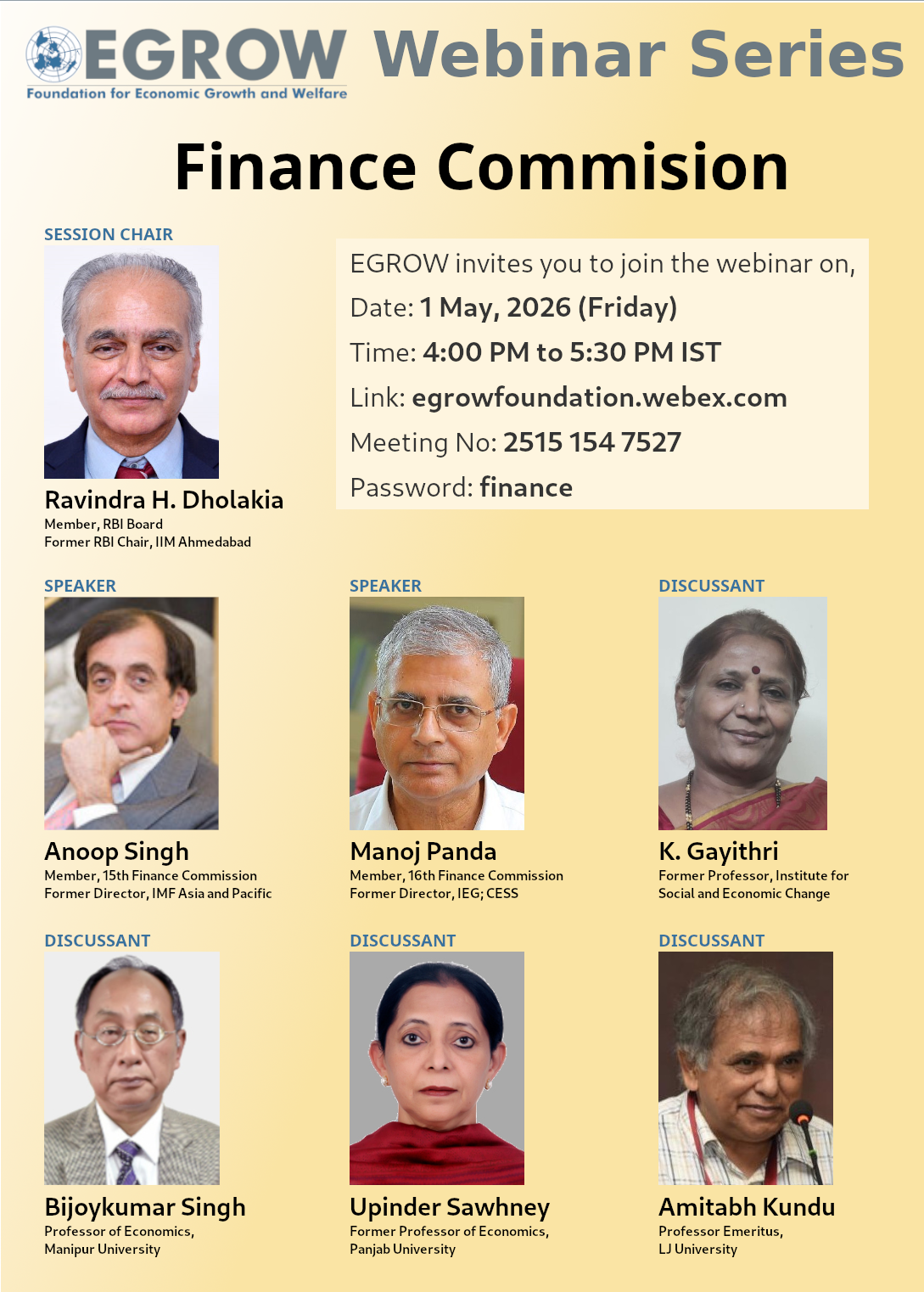
Finance Commision
Webinar Link
Meeting No: 2515 154 7527
Password: finance
Certificate of Participants
To recieve certificates, please register and attend
Abstract
The Sixteenth Finance Commission assumes particular significance in the evolving trajectory of India’s fiscal federalism as it confronts challenges that differ in important ways from earlier Finance Commissions. While previous Commissions largely focused on tax devolution, revenue deficit grants, fiscal consolidation, and local body transfers, the current Commission is expected to address emerging concerns such as climate finance, disaster resilience, demographic shifts, regional inequalities, and public debt sustainability. In this context, the webinar will reflect on how the Sixteenth Finance Commission builds upon, while potentially departing from, earlier approaches through a rethinking of devolution criteria, grants architecture, and performance-linked incentives.
The discussion will examine whether traditional parameters such as income distance, population, forest cover and tax effort require recalibration in light of contemporary realities, and how newer priorities—such as climate-sensitive transfers, green transition financing, stronger local government finances, and incentives for governance reforms—can be integrated into transfer design. Particular attention will be given to recommendations that may distinguish the Commission, including equalisation-oriented transfers, more predictable intergovernmental transfers, debt sustainability frameworks, and sector-specific grants. By situating the Sixteenth Finance Commission in comparative perspective, the webinar seeks to identify pathways through which its recommendations can strengthen cooperative federalism, promote balanced regional development, and support inclusive and sustainable growth.
About the Panel
SESSION CHAIR
Ravindra H. Dholakia
Dr. Ravindra H. Dholakia, a retired Professor of IIM, Ahmedabad, has more than 38 years of experience in regional economic development, economic analysis and policy, international economics and health economics. Earlier, he has served as a consultant to State and Central governments, private sector institutions and international organizations such as WHO, UNICEF, ADB and World Bank. He has also been a member of various committees appointed by the Government and has more than 140 research papers and 22 books to his credit.He holds a post-doctoral research fellowship from the University of Toronto and a PhD in Economics from M S University, Baroda.
SPEAKERS
Prof. Anoop Singh
Prof. Anoop Singh has been Member,15th Finance Commission of India, in the rank of Union Minister of State. The Finance Commission is a constitutional body that recommended tax sharing and grant transfers between the Union and the States for the period 2021-2026.
He is Distinguished Fellow at the Centre for Social and Economic Progress (CSEP, the Brookings India successor) in New Delhi, and has recently been adjunct Professor at Georgetown University,Washington DC.
Before that, at the International Monetary Fund, he was Director of the Asia and Pacific Department, Director of the Western Hemisphere Department, and Director of Special Operations.
His additional work experience includes being Special Advisor to the Governor of the Reserve Bank of India. He has also been Managing Director and Head of Regulatory Affairs, Asia Pacific, for JP Morgan. Mr. Singh holds degrees from the universities of Bombay, Cambridge, and the London School of Economics.
Prof Manoj Panda
Dr Manoj Panda is former Director of the Institute of Economic Growth, Delhi and the Centre for Economic and Social Studies (CESS), Hyderabad.
He has served as Professor at the Indira Gandhi Institute of Development Research, Mumbai and as Senior Economist at the National Council of Applied Economic Research, Delhi. He has worked as a member of several academic and non-academic bodies including the National Statistical Commission, the Financial Sector Regulatory Appointment Search Committee, the Third Pay Revision Committee for Central Public Sector Enterprises, and Board of Governors of research institutions.
He holds a Ph.D. degree in Economics from the Indian Statistical Institute and spent a year at the Yale University, USA on a post-doctoral fellowship.He has undertaken short term assignments for several international organizations such as the World Bank, ADB, FAO, UN-ESCAP and the Carnegie Endowment for International Peace.
His research areas cover monitoring and analysis of macroeconomic trends and prospects, development of macroeconomic models, interaction of human development, poverty and carbon emission with economic growth.He has published a number of research papers in academic journals and books published by international and national publishing houses.
DISCUSSANTS
K. Gayithri
K. Gayithri is Former Professor, Institute for Social and Economic Change. She specializes in the area of Public Economics, Industrial Economics and Public policy studies. She has conducted extensive research in the area of state fiscal studies, public expenditure planning and management, Budget reforms. She has served as an advisor on a number of state government committees and as consultant to international donor agencies like USAID and DFID in state level fiscal studies. She has been a recipient of Shastri Indo Canadian faculty research fellowship twice to undertake comparative fiscal studies at the Carleton University, Canada. She has undergone training at the Duke Center for International development, Duke University on aspects relating to ‘public budgeting and financial management’. She has also participated in the executive education program on ‘Public financial management in a changing world’ at the John F Kennedy School of government at the Harvard University, Boston.
E. Bijoykumar Singh
E. Bijoykumar Singh is Professor of Economics at Manipur University. He has been teaching Econometrics and Microeconomics at PG level and Data base of the Indian Economy at M.Phil/Ph.D. level. His areas of interest are Development Issues of North Eastern Region of India including border trade, Public Finance and Econometrics. He is an active member of North eastern Economic Association, the Indian Econometric Society, the Indian Economic Association and Manipur Economic Association. He has edited 3 books and written extensively on various aspects of development in the northeastern region of India.
Upinder Sawhney
Upinder Sawhney is an Expert at EGROW Foundation. She is a distinguished economist and a former professor at Panjab University, Chandigarh. She served as Chair of the Department of Economics from 2007-2010 and 2016-2019, and has extensively published on public policy issues related to Indian Economy in both national and international journals. She led various international and domestic projects, including the Government of India's Scheme for Promotion of Academic and Research Collaboration (SPARC) with Copenhagen Business School, Denmark, and University of Wurzburg, Germany, titled "Macroeconomic Effects of Ageing in India – Lessons from European Union," and a World Bank-sponsored Budgetary Analysis at the State Level, 2004-05. She contributed to various committees, such as the Fourteenth Finance Commission and the Regional Direct Taxes Advisory Committee.
Amitabh Kundu
Amitabh Kundu is currently Professor Emeritus at LJ University, Visiting Professor at Maulana Azad National Urdu University. He was Distinguished Fellow at Research and Information System for Developing Countries. He was Regional Advisor on Poverty at UNESCWA, Beirut during 2017 and Consultant to the Government of Sri Lanka during 2016. Until January 2014, he was Professor at the Jawaharlal Nehru University, New Delhi. He has been the Dean of the School of Social Sciences and has served as a member of National Statistical Commission during 2006-08. He is also the chairperson of Samarthan, a large grassroots level institution working for the poor and vulnerable.
He has been a Visiting Professor at the University of Amsterdam, Sciences Po and Maison des Sciences de L’homme in Paris, University of Kaiserslautern and University of Wuerzburg in Germany. He has worked as Director at various institutes in India and is in the Editorial Board of Manpower Journal, Urban India, Journal of Educational Planning and Administration, Indian Journal of Labour Economics. He has about thirty-five books and three hundred research articles, published in India and abroad, to his credit.