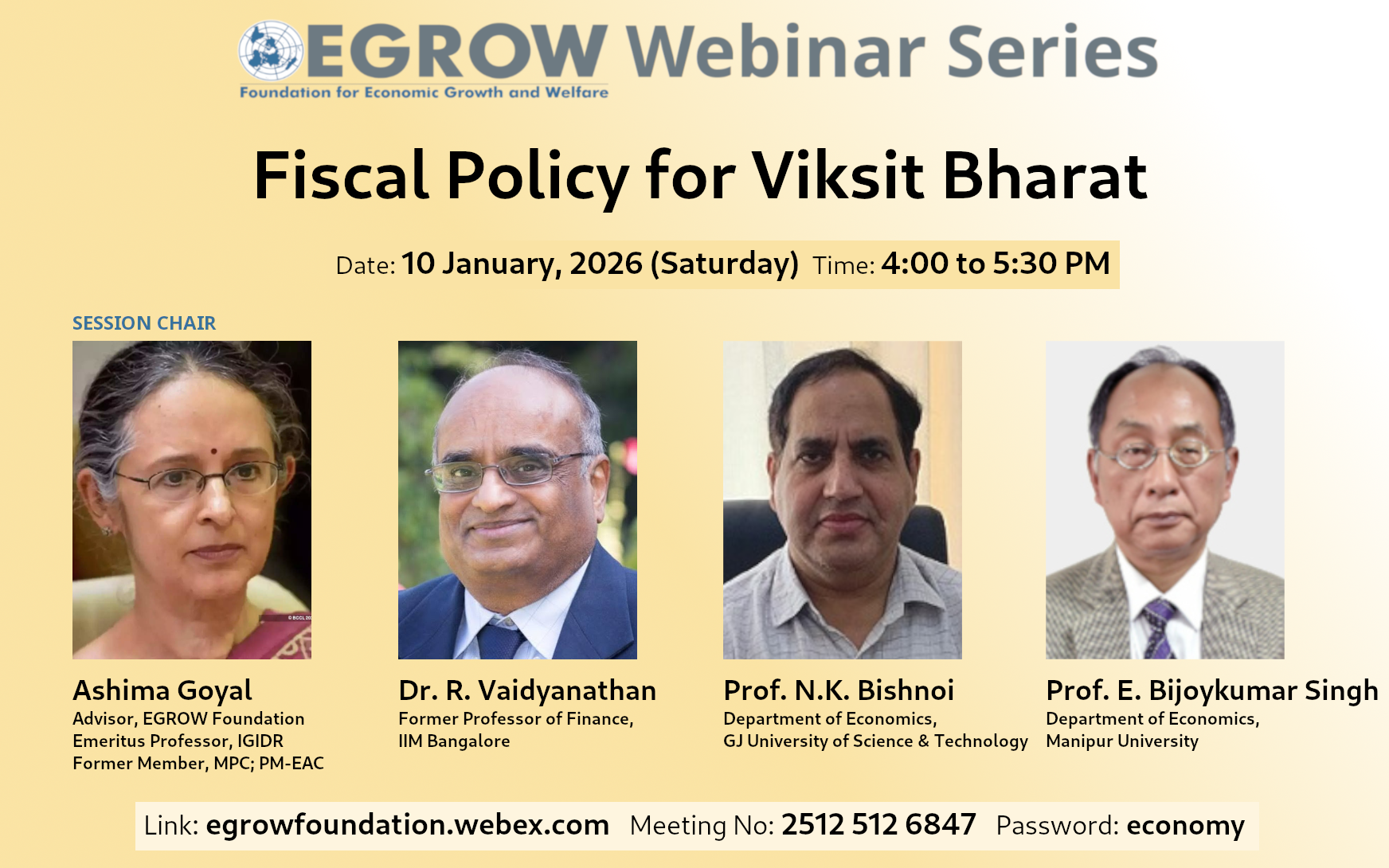
Fiscal Policy for Viksit Bharat
Webinar Link
Meeting No: 2512 512 6847
Password: economy
Certificate of Participants
To recieve certificates, please register and attend
Abstract
Fiscal policy remains central to India’s Viksit Bharat vision, anchoring the pursuit of high growth with macroeconomic stability and fiscal sustainability. Building on the consolidation achieved in recent years, the Union Budget 2026–27 is expected to further advance the fiscal correction path initiated in Budget 2025–26, which targeted a fiscal deficit of 4.4 per cent of GDP. The continued emphasis on calibrated deficit reduction, alongside sustained developmental spending, reflects the government’s commitment to credible fiscal management.
Capital expenditure is likely to remain a key policy lever in Budget 2026–27, reinforcing investments in infrastructure, healthcare, education, and green transition, thereby strengthening long-term productivity and crowding in private investment. The controlled deficit trajectory observed in the first half of FY26 supported by buoyant non-tax revenues and efficient expenditure managemen —provides fiscal space for sustained public investment without compromising stability.
With India’s medium-term GDP growth outlook remaining robust, fiscal policy in 2026–27 is expected to leverage growth dividends to enhance revenue mobilization, rationalize subsidies, and improve the quality of expenditure. Prudent borrowing strategies, combined with reforms in tax administration and asset monetization, will be critical to maintaining debt sustainability.Thus, the Union Budget 2026–27 is poised to strengthen the foundations for inclusive, resilient, and sustainable growth, aligning fiscal strategy with India’s long-term aspiration of becoming a developed economy.
About the Speakers
Ashima Goyal
Ashima Goyal is Advisor at EGROW Foundation. She has provided consultancy to ADB, DEA, GDN, UNDP, RBI, UN ESCAP and WB. She is active in the Indian policy debate; and has served on several government committees, including the Economic Advisory Council Prime Minister and the RBI technical advisory committee for monetary policy, and boards of educational and of financial institutions. She is former Member of RBI's Monetary Policy Committee, an independent director at Edelweiss Financial Services and SBI General Insurance.
Ashima Goyal edits a Routledge journal in macroeconomics and finance and contributes a monthly column to the Hindu Business Line. She was a visiting fellow at the Economic Growth Centre, Yale University, USA, and a Fulbright Senior Research Fellow at Claremont Graduate University, USA. Her research has received national and international awards. She won two best research awards at GDN meetings at Tokyo (2000) and Rio de Janeiro (2001), was selected as one of the four most powerful women in economics, a thought leader, by Business Today (2008); was the first Professor P.R. Brahmananda Memorial Research Grant Awardee for a study on History of Monetary Policy in India since Independence (2011), which was published by Springer in 2014; received the SKOCH Challenger Award for Economic Policy (2017); Hindu College OSA Distinguished Alumni Award and 20th FLO FICCI GR8 Beti Award for Excellence in Economics (2018).
Ashima Goyal is widely published in institutional and open economy macroeconomics, international finance and governance, with more than a hundred articles in national and international journals. She has also authored and edited a number of books including Macroeconomics and Markets in Developing and Emerging Economies (Routledge: UK. 2017) and A Concise Handbook of the Indian Economy in the 21st Century (OUP: India, 2019).
Dr. R. Vaidyanathan
Dr. R. Vaidyanathan, a retired Professor of Finance from IIM Bangalore, holds an illustrious academic background. He graduated from Loyola College, Madras, and completed his Master's degree at the Indian Statistical Institute, Calcutta. He earned his Doctorate from the Indian Institute of Management Calcutta, where he also served as a faculty member for four years.
Dr. Vaidyanathan boasts a distinguished career, having been honored twice as a Fulbright scholar and recognized as a Fellow of ICSSR. He has held visiting faculty positions at esteemed universities in the USA and UK. His expertise led to his selection as one of the top ten professors across all IIMs by Business Today.
Beyond academia, Dr. Vaidyanathan's influence extends to regulatory committees, including SEBI, RBI, IRDA, and PFRDA. He serves as a consultant to numerous organizations and holds positions on various corporate boards.
His outstanding contributions to the field have earned him prestigious awards, such as the Life Contribution Award from the Asia Pacific Risk and Insurance Association (APRIA) and KYBO LIFE in 2019. Dr. Vaidyanathan is a renowned author, with notable books like "India Uninc- Role of Non-corporate Sectors in India," which explores Indian and Asian value systems, and "Black Money and Tax Havens," acclaimed by experts. His latest work, "Caste as Social Capital," has garnered acclaim in the market.
Dr. Vaidyanathan's advisory roles include positions on the Advisory Council of Vivekananda International Foundation (VA) and membership on the "National Security Advisory Board" under the National Security Council. He also serves as an Adjunct Professor at AURO University in Surat and holds the Cho. S. Ramaswamy Chair Professorship in Public Policy at Sastra University. He is also an Emeritus adjunct professor of Rashtriya Raksha University [RRU] an institution of national importance at Ahmedabad.
Prof. N.K. Bishnoi
Narendra Kumar Bishnoi is the Professor, Department of Economics, Guru Jambheshwar University of Science and Technology. He has 32 years of teaching experience. His expertise spans Economic & Fiscal Policy Analysis, Regional Competitiveness Analysis, and Venture Capital. He has contributed to various state finance commissions in Haryana, developed case studies for the UNDP, and served on national committees. He has worked with the UNDP, World Bank, and other major organizations. He has authored over 80 research papers and successfully completed 22 research projects and mentored over 16 PhD scholars. He also engages in popular writing and media discussions, and currently mentors start-ups, including one focused on developing an artificial bionic hand at IIT Delhi’s Technology Incubation Center.
Prof. E. Bijoykumar Singh
E. Bijoykumar Singh is Professor of Economics at Manipur University. He has been teaching Econometrics and Microeconomics at PG level and Data base of the Indian Economy at M.Phil/Ph.D. level. His areas of interest are Development Issues of North Eastern Region of India including border trade, Public Finance and Econometrics. He is an active member of North eastern Economic Association , the Indian Econometric Society ,the Indian Economic Association and Manipur Economic Association. He has edited 3 books and written extensively on various aspects of development in the northeastern region of India.