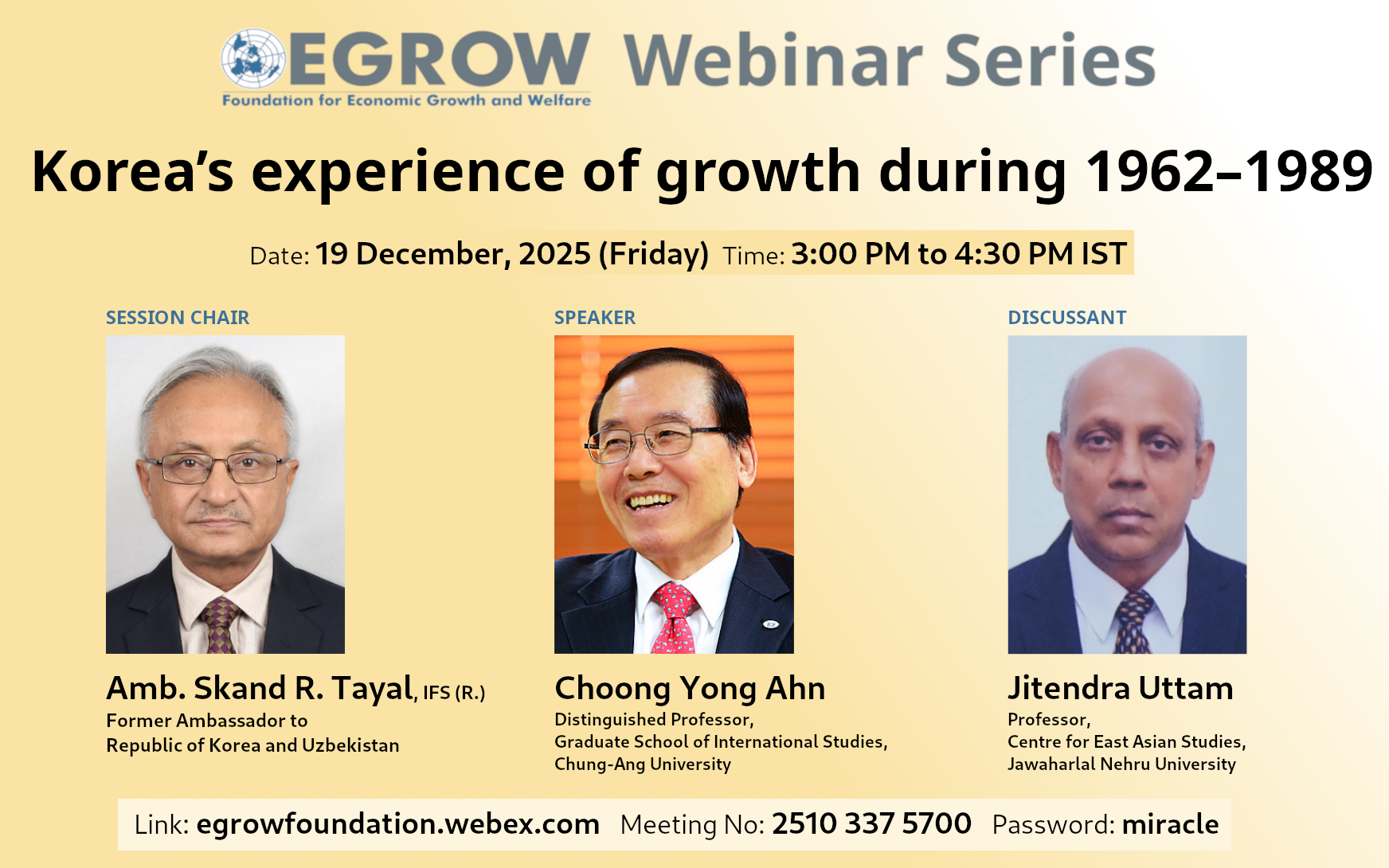
Korea’s experience of growth during 1962–1989
Webinar Link
Meeting No: 2510 337 5700
Password: miracle
Certificate of Participants
To recieve certificates, please register and attend
Abstract
During 1962–1989, South Korea underwent a transformative "Miracle on the Han River," evolving from an impoverished agrarian nation into an industrial powerhouse. This rapid development was driven by an aggressive, state-led, outward-oriented industrialization strategy. The government utilized a series of five-year plans, actively promoting key heavy and chemical industries and fostering large conglomerates (Chaebols) with strong incentives. This policy resulted in soaring export volumes (growing 30% annually), massive structural economic changes, and significant investment in a highly educated workforce. The webinar will examine this period was marked by high growth rates achieved under an authoritarian regime focused intensely on "nation-building through exports," ultimately laying the foundation for modern South Korea's robust economy.
About the Speaker
Skand Ranjan Tayal
Ambassador (Retd) Skand Ranjan Tayal is a graduate of Allahabad University and has a Post-Graduate Degree in Chemistry from the prestigious IIT, Kanpur. After joining the Indian Foreign Service (1976), Ambassador Tayal served in Indian Missions in Sofia, Warsaw, Geneva and Moscow. He was India’s Consul General in Johannesburg (1996-98) and Houston (2002-05), and Ambassador of India to Uzbekistan (2005-08). He was Ambassador of India to the Republic of Korea during 2008-11. Amb.Tayal was on the Board of Hindustan Shipyard Limited (Vizag) and MMTC Limited as an independent director during 2013-16 and is Chairperson of the India-Republic of Korea Friendship Society. He was also Chairman of the Governing Board of Dyal Singh College in New Delhi during 2013-16. He was a Visiting professor in the Delhi University during 2013-16. Ambassador Tayal has authored a book ‘India and Republic of Korea: Engaged Democracies’ which was released in December 2013 by the Hon’ble External Affairs Minister of India.
Choong Yong Ahn
Dr. Choong Yong Ahn is currently Distinguished Professor at the Graduate School of International Studies, Chung-Ang University Seoul. He is also Co-Chair of the Korea-India Strategic Dialogue organized by the Seoul International Forum. Previously, he was Chairman, Korea Commission for Corporate Partnership (KCCP: 2014-2018) to induce voluntary collaborations between Korea’s big businesses and SMEs, and also Chairman of the Board, Korea Electric Power Corporation. Before taking the KCCP post, he served as presidentially appointed Foreign Investment Ombudsman (2006-2014) for foreign direct investors in Korea. He is also former Chairman of the Presidential Regulatory Reform Committee (2010-2012). While on sabbatical from Chung-Ang University, he also served several posts such as the President of the Korea Institute for International Economic Policy (2002-2005); Chair of the APEC Economic Committee (2002-2005); Chair of Board, Choheung Bank; consultant to the World Bank; UNIDO Chief Technical Advisor to the Economic Planning Unit of Malaysia to design Malaysia's industrial master plan; and served as President of several academic societies in Korea including the Korea International Economics Association, Korean Association of Trade and Industry Studies, and the Korea Econometric Society. He was also a visiting professor to Economic Research Institute, Kyoto University, Japan. Dr. Ahn’s honors include the Economist of the Year Award from the Maeil Business Daily Newspaper in Korea, the Okita Policy Research Award by the National Institute for Research Advancement in Japan for his publication on “Modern East Asian Economy,” and Free Economy Publication Award by the Federation of Korean Industries.
Jitendra Uttam
Professor Jitendra Uttam is currently the Chairperson of the Centre for East Asian Studies, School of International Studies, Jawaharlal Nehru University, New Delhi, India. He was awarded a Korean Government Fellowship, which became the Global Korea Scholarship (GKS) in 1993. He completed his PhD from Korea’s Seoul National University in 2002. His area of expertise includes Comparative International Political Economy, with emphasis on Korea/India/East Asia. He has published three books; ‘The Political Economy of Korea: Transition, Transformation and Turnaround’ (Palgrave Macmillan, 2014); ‘Varieties of Capitalism in Asia: Beyond the Developmental State’, co-authored with David Hundt (London: Palgrave Macmillan, 2017; and ‘Political Economy of Financial Systems: Korean and Indian Experiences in Retrospect’, (London: Cambridge Scholars Publishing, 2025). He has also published several papers in journals including, “Making of the ‘Korean Question’: A Reassessment of India’s Position at the United Nations”, International Journal of Korean Unification Studies 29 (2), (2020): 107-142; “Between Buddhist 'Self-enlightenment and 'Artificial Intelligence: Korea Emerging as a New Balancer”, Religions, (Switzerland) V0l.14 (2023): 1-14; and “Beyond Neo-liberalism: Analysing the ‘Post-Developmental State’ in South Korea’, International Studies, 56 (4), (2019): 236-254.