Lessons from Climate Crisis in Nepal
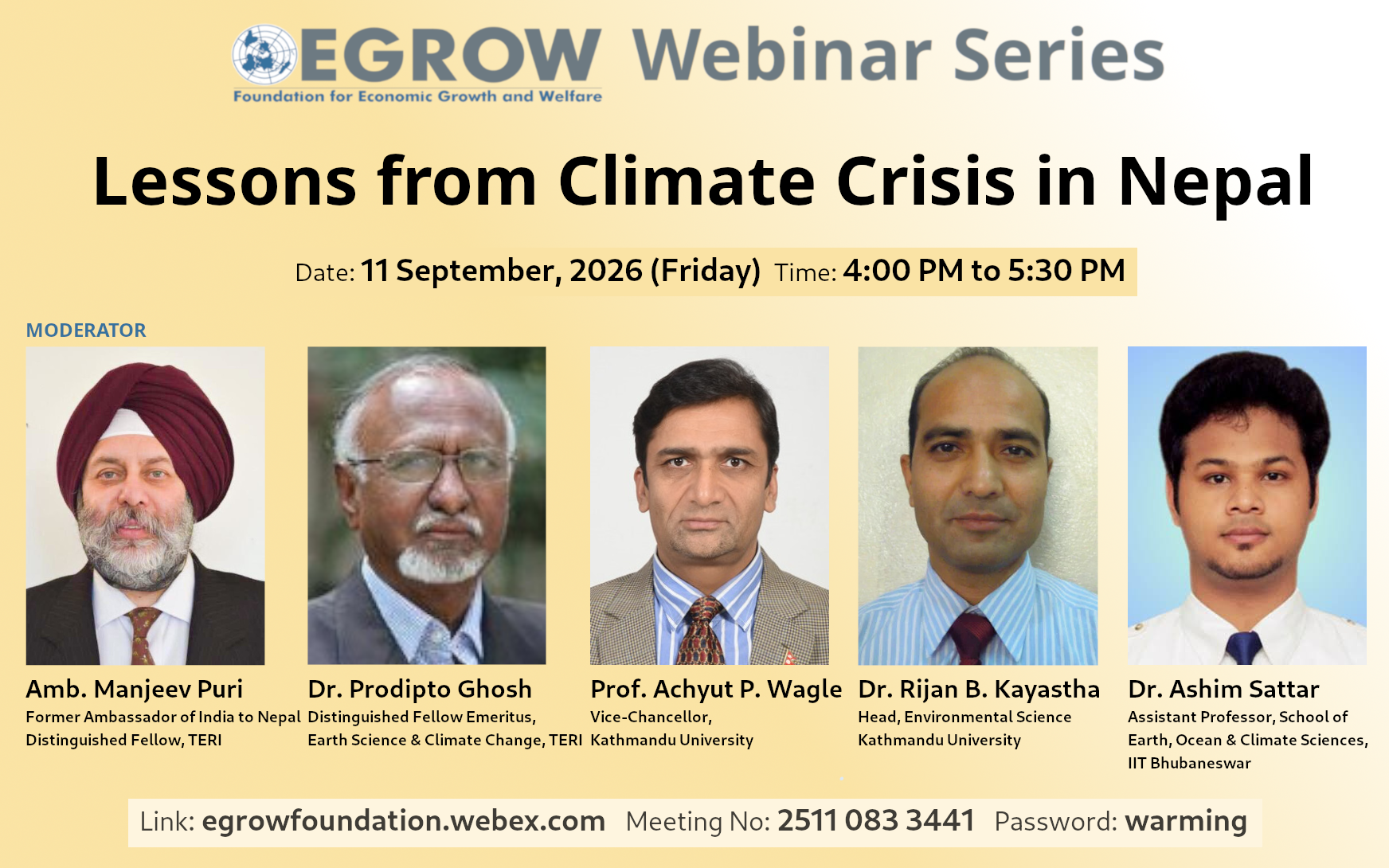
Webinar Link
Meeting No: 2511 083 3441
Password: warming
Certificate of Participants
To recieve certificates, please register and attend
Abstract
Nepal is increasingly experiencing the impacts of the climate crisis, including rising temperatures, changing rainfall patterns, floods, landslides, droughts, and glacial lake outburst floods. These challenges threaten agriculture, livelihoods, infrastructure, biodiversity, and vulnerable communities. The importance of climate adaptation, disaster preparedness, community participation, sustainable resource management, and stronger institutional coordination. The climate-resilient development, innovative policies, and regional cooperation. Lessons from Nepal can provide valuable insights for other climate-vulnerable countries.This webinar examines key lessons from Nepal’s experience in responding to climate-related risks and building resilience.
Short Bio
Amb. Manjeev Puri
Manjeev Singh Puri is presently Distinguished Fellow at The Energy and Resources Institute (TERI) and a Distinguished Visiting Fellow with the Ananta Centre. He is a former Indian Ambassador. He joined the Indian Foreign Service in 1982 and served as Ambassador of India to the European Union, Belgium, Luxembourg (2013-2017) and Nepal (2017-2019). He has also served as Ambassador/Deputy Permanent Representative of India to the UN from 2009-2012, a period during which India was on the Security Council. Prior to that, from 2005-2009, he headed the division in the Ministry of External Affairs dealing with UN issues on the social and economic side. In addition, he has served twice in Germany (in Bonn and Berlin), in Cape Town, Muscat, Bangkok and Caracas. He retired on 31 December 2019 in the rank of Secretary, Government of India.
Major areas of his experience relate to multilateralism (UN), Europe and Nepal and he was involved as a lead member of the Indian delegation at numerous global negotiations on, migration, human rights and UN reforms. His professional focus has been on issues relating to the environment, climate change and sustainable development. He was a lead negotiator for India at the UN on issues relating to the post 2015 development agenda, Sustainable Development Goals and at the UN Conference on Sustainable Development held in Rio de Janeiro, Brazil in June 2012. He was a key member of India's delegation at various Climate Change negotiations, including the Conference of Parties of the UNFCCC in Copenhagen in December 2009 and before that at Montreal, Bali, Bonn and Poznan. Furthermore, he was involved with India's participation in the G8-G5 Summits from 2005 and was the point-person for the Major Economies Forum.
Dr. Prodipto Ghosh
Dr. Prodipto Ghosh works at the intersection of science, economics, philosophy, and public policy. Until June 2026, he was Distinguished Fellow at The Energy and Resources Institute (TERI). A former member of the Indian Administrative Service (1969–2007), he retired as Secretary, Ministry of Environment, Forests and Climate Change. He also served as Economic Advisor and Additional Secretary to the Prime Minister, Additional Secretary in the Department of Economic Affairs, and Senior Environment Specialist at the Asian Development Bank. Dr. Ghosh represented India in UNFCCC climate negotiations (2001–2012) and other major environmental treaty negotiations. He has served on several national advisory bodies and held academic appointments at Carnegie Mellon University, TERI School of Advanced Study, and Smith College, Oxford. He has authored around 40 research publications and edited volumes on climate change and sustainability. He holds a Ph.D. from Carnegie Mellon University and a B.Tech. from IIT Delhi, and has received distinguished alumni awards from both institutions.
Prof. Achyut P. Wagle
Prof. Achyut Prasad Wagle is the Vice-Chancellor of Kathmandu University. Earlier, he held the positions of Registrar of the university, Associate Dean of the School of Management, and Head of the Management Science Department at the School of Management.
Prof. Wagle has also held several important public positions including Advisor to the Prime Minister of Nepal and Advisor to the Governor of Nepal Rastra Bank, the Central Bank of the country. He is a seasoned fortnightly columnist for The Kathmandu Post and Kantipur, the most popular daily newspapers in Nepal. He teaches Econometrics and other core courses on economics and research. His research interests include business environment, regional economy, fiscal federalism and entrepreneurship.He holds a PhD in Economics from the Indian Institute of Technology Kanpur, an MSc in Economics from the University of Birmingham, UK and an MA from Tribhuvan University, Nepal.
Dr. Rijan B. Kayastha
Dr. Rijan Bhakta Kayastha has 25 years of experience on the Himalayan glaciology, glacio-hydrological modeling and mountain hydrology and meteorology. His higher education M. Sc., D. Sc. and JSPS Postdoc was from Nagoya University, Japan and Max-Planck Postdoc from Max-Plank Institute for Bio-geochemistry, Germany. His research areas includes understanding of glacier mass balance by field and modeling techniques, impacts of climate change impact on glaciers and water resources, understanding of glacier variation by field observation, remote sensing and modeling techniques, estimation of ablation by energy balance and positive degree-day models, estimation of current and future discharges from glacierized river basins using different glacio-hydrological models and future climate data, glacier-climate interaction, snow and glacier hydrology of mountain region, extreme weather events, glacial hazard such as glacier lake outburst flood (GLOF), flood and GLOF early warning systems and water and climate induced disaster risk reduction. He has developed a glacier mass balance model and a Glacio-hydrological Degree-day Model (GDM).
Dr. Ashim Sattar
Dr. Ashim Sattar is an Assistant Professor in the School of Earth, Ocean & Climate Sciences at the Indian Institute of Technology (IIT) Bhubaneswar.Dr. Ashim Sattar's research includes various applications of remote sensing and GIS. His research focus is on the cryosphere, including remote sensing-based glacier modeling, and modeling of Glacial Lake Outburst Floods (GLOFs) and other mountain hazards. His research expertise deals with several aspects of high mountain hazards, risks, and adaptation. Dr. Sattar is involved in multi-disciplinary and cross-sectoral research around the globe, including the Himalayas, the Andes, Iceland, and Central Asia, both at a local scale and in regional-scale assessments. His research involves understanding various mass movement processes in high mountain geosystems, focusing on recent dynamics. He is involved in understanding different forms of potential mass movement including landslides, avalanches, and rockfalls.