Monetary policy decision-making and communication under high uncertainty
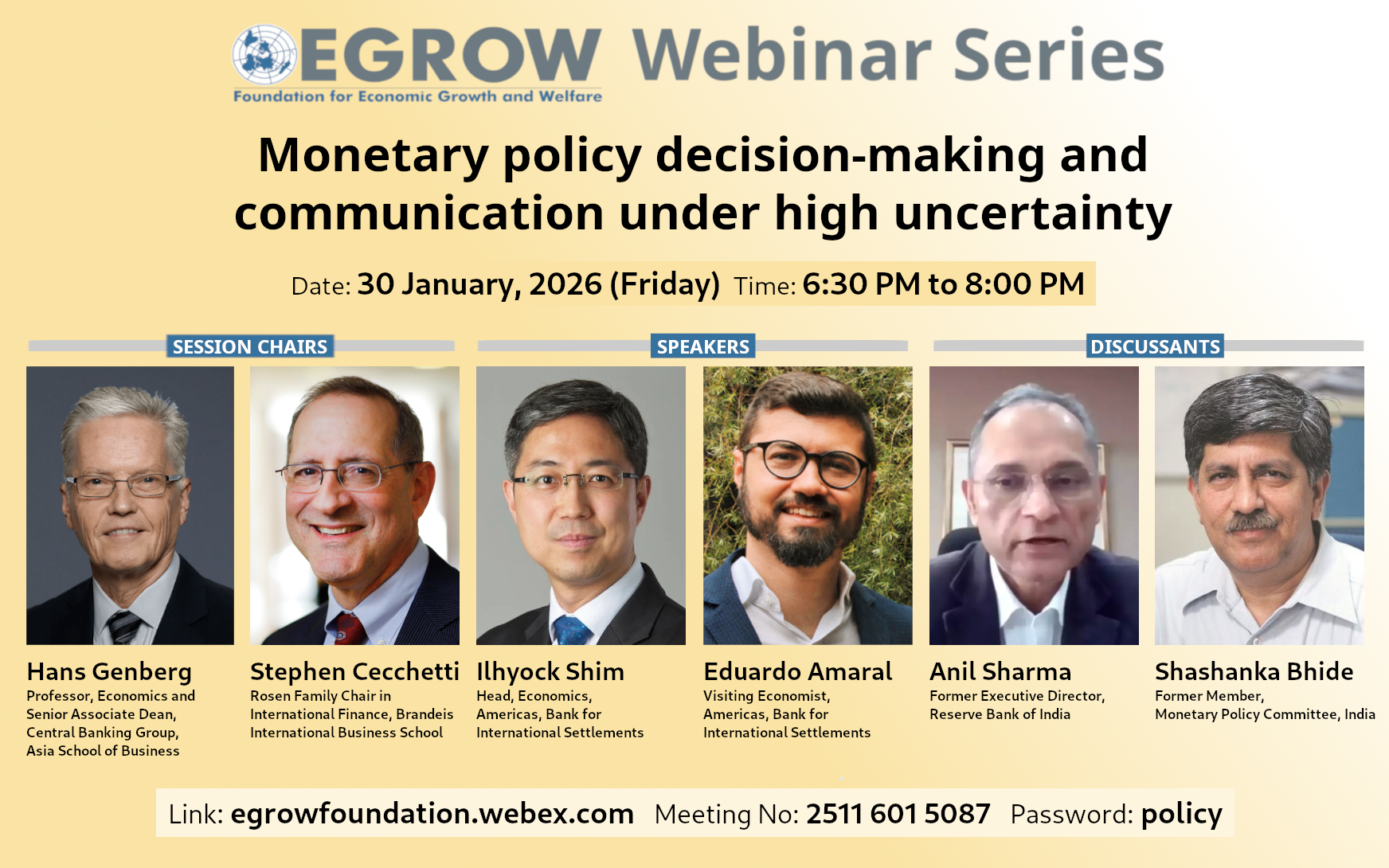
Webinar Link
Meeting No: 2511 601 5087
Password: policy
Certificate of Participants
To recieve certificates, please register and attend
Abstract
Periods of heightened uncertainty have challenged central banks in unprecedented ways. The shocks of recent years – from the Covid-19 pandemic and persistent inflation to volatile financial conditions and geopolitical tensions – have tested the resilience of monetary policy frameworks and the agility of policy responses worldwide. Against this backdrop, central banks have reassessed their analytical tools, decision-making processes and communication strategies to ensure the continued effectiveness and credibility of monetary policy.
The webinar will examine a comprehensive view of how central banks have navigated uncertainty in recent times. Drawing on both survey-based evidence and in-depth case studies from 10 individual central banks, the chapters explore the evolving role of scenario analysis, the integration of high-frequency data and expert judgment, and the increasing importance of transparent and adaptive communication.
About the Speakers
Hans Genberg
Professor Hans Genberg is a Professor of Economics and Senior Associate Dean of Central Banking Group at the Asia School of Business. He has a distinguished academic career as a Professor of Economics at the Graduate Institute of International Studies in Geneva, where he was also Head of the International Economics Department, responsible for the Diploma program, and a member of the Institute’s Executive Committee. He has also had teaching positions at the Graduate School of Business at the University of Chicago and the University of Rochester campus in Switzerland.
During his position as Professor at the Graduate Institute of International Studies, he supervised or co-supervised over thirty doctoral dissertations of students who have since held positions as Central Bank Governors and Deputy Governors, senior officials at the International Monetary Fund, the World Bank, the Bank for International Settlements, and the Norwegian Oil Fund, and academic positions at universities such as HEC Montreal, Boston College, New York University, and Wharton.
He has published over fifty scholarly papers and edited several books on issues related to central bank policy, international monetary relations, exchange rate regimes, reserve management, capital markets development, and monetary and financial issues in Asia. Professor Genberg holds a PhD in Economics from the University of Chicago.
Stephen Cecchetti
Stephen G. Cecchetti is the Rosen Family Chair in International Finance at the Brandeis International Business School, Vice-Chair of the Advisory Scientific Committee of the European Systemic Risk Board, Research Associate of National Bureau of Economic Research, and Research Fellow of the Centre for Economic Policy Research. Before rejoining Brandeis in 2014, he completed a five-year term as Economic Adviser and Head of the Monetary and Economic Department at the Bank for International Settlements. In addition to his other appointments, Cecchetti served as Director of Research at the Federal Reserve Bank of New York; Editor of the Journal of Money, Credit, and Banking. Cecchetti has published widely in academic and policy journals, and is the author of a leading textbook in money and banking.
Eduardo Amaral
Mr Amaral joined the BIS Office for the Americas in October 2024. At the Central Bank of Brazil since 2010, Eduardo carried out policy-oriented analysis and research on economic activity, financial markets, monetary policy and the credit sector. During that period, he was a deputy advisor for the Economic Department and also worked for the Open Market Operations Department. His research is focused on fiscal and monetary policy interactions. Eduardo holds a PhD in economics from the Pontifícia Universidade Católica of Rio de Janeiro (Brazil).
Ilhyock Shim
Mr Shim has been Head of Economics for the Americas since January 2025. He conducts research and policy analysis on financial markets, financial stability and international finance. He began his career as deputy director in the Korean government in 1996. In 1997–1999, he worked at Korean Ministry of Finance and Economy as deputy director in charge of deposit insurance and financial sector restructuring. He joined the BIS in Basel in 2004 as economist. From September 2007 to April 2018, he worked at the BIS Asian Office in Hong Kong SAR as principal economist. In 2010, he worked for the G20 Affairs Office of the Bank of Korea as adviser. In 2018, he worked in Basel as Special Adviser on International Financial Stability Policy in charge of FSB and G20 matters. In 2019–2023, he worked as Head of Economics and Financial Markets for Asia-Pacific in Hong Kong SAR. In 2024, he worked as Head of Financial Systems and Regulation in Basel. He published articles on asset managers, banking regulation, bond markets, capital flows, capital flow management measures, equity markets, financial channels of exchange rates, FX markets, household debt, macro-financial stability framework and macroprudential policy. He holds a BA and a MA in Economics from Seoul National University, and a PhD in Economics from Stanford University.
Anil Sharma
Anil Kumar Sharma was the Executive Director, Reserve Bank of India. Before taking over as ED, he was headed the Enforcement Department of Reserve Bank of India as Chief General Manager. He has done his Masters in Economics from Doaba College Jalandhar, Punjab and was UGC Fellow at Gokhale Institute of Politics and Economics, Pune before joining RBI in 1986. He holds a Diploma in Treasury and Risk Management and is a Certified Associate of Indian Institute of Bankers. His experience in the Bank lies in the area of management of currency and banking, rural credit, and supervision. He also worked as member of faculty in RBI College of Agricultural Banking, Pune.
Shashanka Bhide
Shashanka Bhide is a Former Member at Monetary Policy Committee, India and Honorary Senior Advisor at the National Council of Applied Economic Research (NCAER). He was with NCAER from 1982 to 2014 in different capacities. He took up the position of Director, Madras Institute of Development Studies, Chennai in July 2014 and served in this position until December 2018. He joined NCAER in the present position in September 2019. His research has covered a number of areas in agriculture, macroeconomic modeling, infrastructure, and poverty analysis. He has published extensively, including co-authoring and editing books and journal articles in these fields. During 2003 – 2004, while on leave from NCAER, he was Professor at Social and Economic Change in Bangalore.
His research interests include applied economic analysis in a range of areas covering agriculture, poverty analysis, macroeconomic modelling and infrastructure development. He has published his research in academic journals, books and other media. His recent co-edited books include ‘Poverty, Chronic Poverty and Poverty Dynamics, Policy Imperatives’, Springer, 2018 and ‘Deciphering India’s Services Sector Growth’, Routledge, 2021.