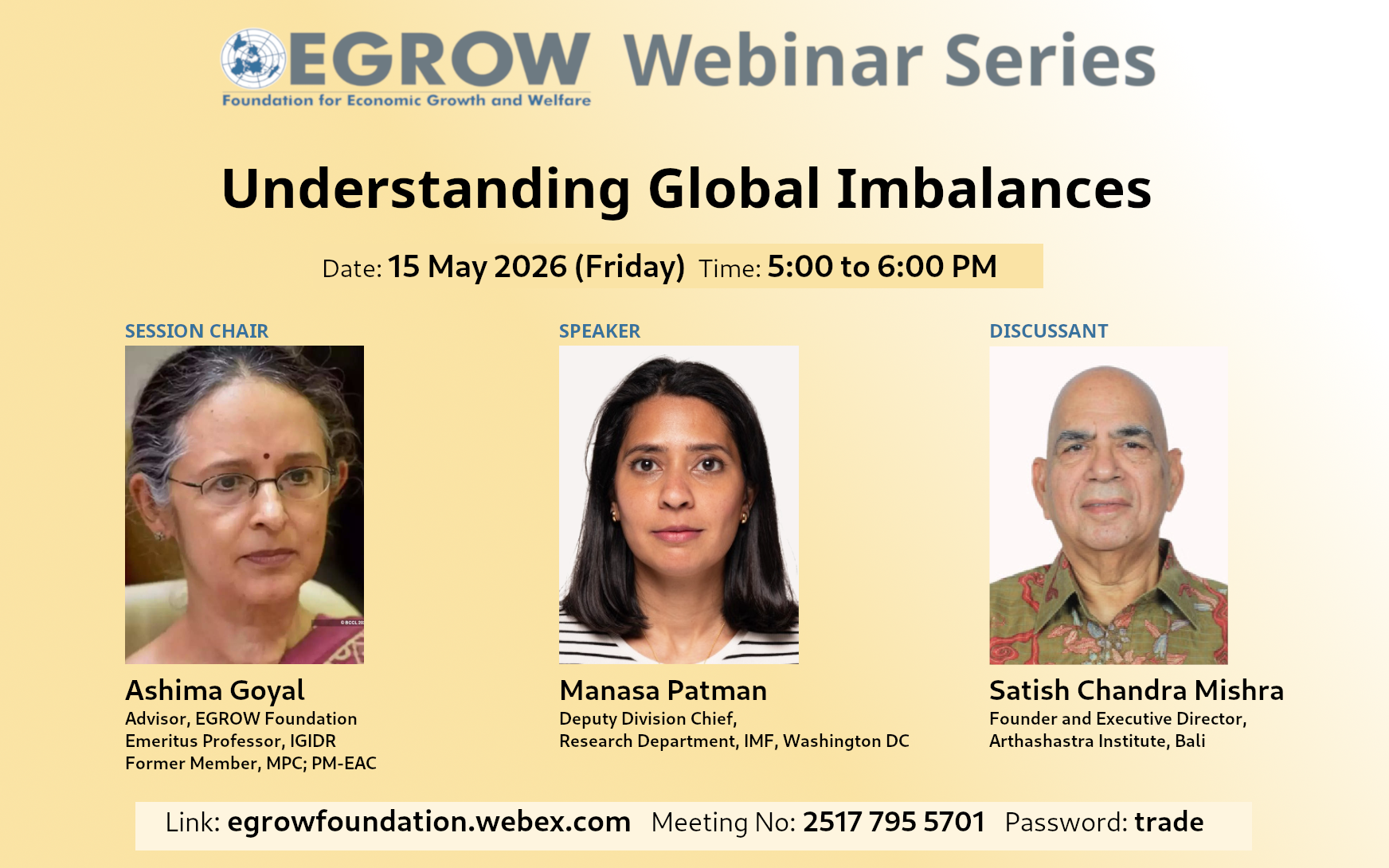
Understanding Global Imbalances
Webinar Link
Meeting No: 2517 795 5701
Password: trade
Certificate of Participants
To recieve certificates, please register and attend
Abstract
Against the backdrop of persistent and widening global imbalances, current account positions across economies are increasingly shaped by structural conditions, domestic macroeconomic policies and policy-driven interventions. Saving, investment and consumption patterns influence external balances, while industrial policies and capital flow management can reshape these outcomes in different ways. Micro-level industrial interventions targeting specific sectors often have limited and uncertain effects on current accounts, whereas broader macro-industrial strategies may significantly influence external balances, sometimes at the cost of reduced domestic consumption. Trade restrictions introduced to correct imbalances also tend to produce meaningful results only when temporary or supported by stronger public savings. The webinar critically examines these dynamics and explores how coordinated domestic rebalancing by both surplus and deficit economies, along with international cooperation, policy coordination, enhanced surveillance and deeper policy dialogue, can contribute to sustainable and balanced global economic development.
About the Speakers
Ashima Goyal
Ashima Goyal is Advisor at EGROW Foundation. She has provided consultancy to ADB, DEA, GDN, UNDP, RBI, UN ESCAP and WB. She is active in the Indian policy debate; and has served on several government committees, including the Economic Advisory Council Prime Minister and the RBI technical advisory committee for monetary policy, and boards of educational and of financial institutions. She is former Member of RBI's Monetary Policy Committee, an independent director at Edelweiss Financial Services and SBI General Insurance.
Ashima Goyal edits a Routledge journal in macroeconomics and finance and contributes a monthly column to the Hindu Business Line. She was a visiting fellow at the Economic Growth Centre, Yale University, USA, and a Fulbright Senior Research Fellow at Claremont Graduate University, USA. Her research has received national and international awards. She won two best research awards at GDN meetings at Tokyo (2000) and Rio de Janeiro (2001), was selected as one of the four most powerful women in economics, a thought leader, by Business Today (2008); was the first Professor P.R. Brahmananda Memorial Research Grant Awardee for a study on History of Monetary Policy in India since Independence (2011), which was published by Springer in 2014; received the SKOCH Challenger Award for Economic Policy (2017); Hindu College OSA Distinguished Alumni Award and 20th FLO FICCI GR8 Beti Award for Excellence in Economics (2018).
Ashima Goyal is widely published in institutional and open economy macroeconomics, international finance and governance, with more than a hundred articles in national and international journals. She has also authored and edited a number of books including Macroeconomics and Markets in Developing and Emerging Economies (Routledge: UK. 2017) and A Concise Handbook of the Indian Economy in the 21st Century (OUP: India, 2019).
Manasa Patman
Manasa Patnam is the Deputy Division Chief of the Multilateral Surveillance Division in the Research Department of the International Monetary Fund (IMF). Prior to her current role, she held positions in the IMF's European Department and Strategy, Policy, and Review Department, contributing to country surveillance and program work, policy design and review, as well as multilateral research on topics including innovation, macroprudential policy, fintech, and financial inclusion. Before joining the Fund, she was an Assistant Professor of Economics at ENSAE ParisTech and CREST. She holds a Ph.D. in Economics from the University of Cambridge. Her research spans global imbalances, international spillovers, economic networks, macroprudential policy, corporate taxation, fintech, and machine learning applications in macroeconomic forecasting. Her work has been published in leading academic journals, including the Journal of Econometrics, the Economic Journal, IMF Economic Review, Journal of Development Economics, Quantitative Economics, Journal of Economic Behavior and Organization, Journal of Banking and Finance, and Economics Letters.
Satish Chandra Mishra
Satish Chandra Mishra is the Founder and Executive Director of the Arthashastra Institute in Bali, where he advances India–Indonesia collaboration through economic research, policy dialogue, and cultural exchange. He has held senior roles across international development and policy, including work with the United Nations Capital Development Fund and leadership positions in Strategic Asia initiatives. He advised ministers in Ethiopia during the final years of the Mengistu regime, contributing to the country’s transition, and served as Chief Macro Economist at USAID across 22 African countries. At the OECD, he supported expansion into Eastern Europe and led missions during the Asian Financial Crisis. In Indonesia, with UNDP, he led UNSFIR and produced an award-winning Human Development Report. He holds a PhD in Economics from the University of Cambridge.