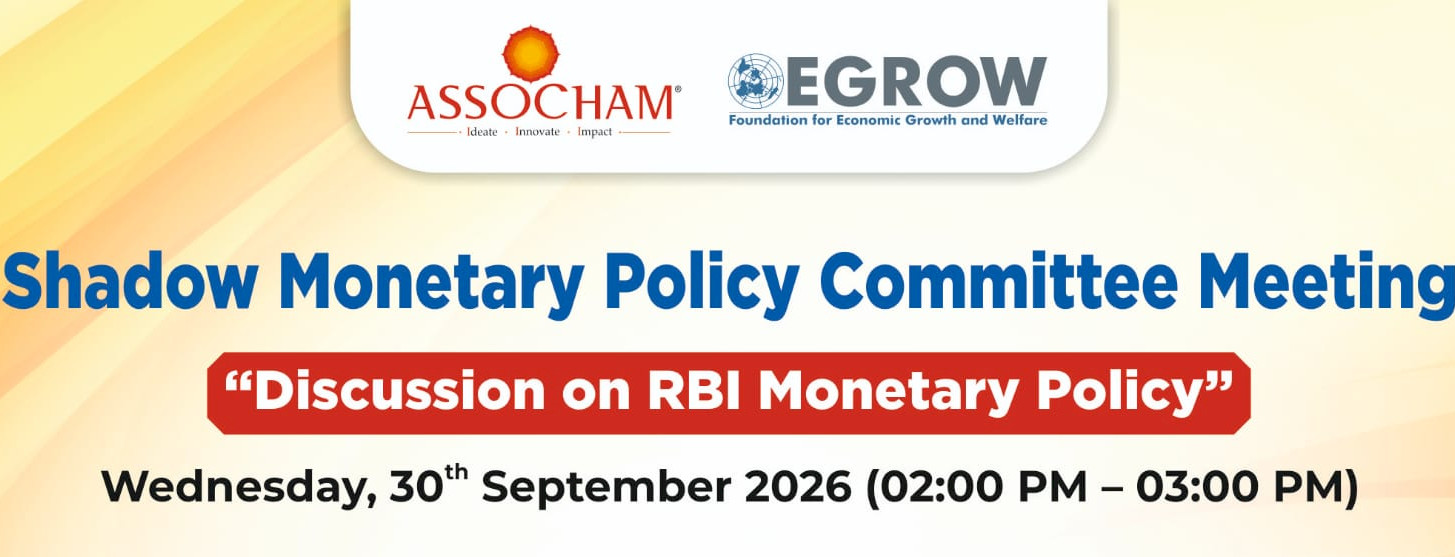
Forty-Eighth EGROW Shadow Monetary Policy Committee Meeting on September 30, 2026
Key Takeaways
- Global uncertainty continues.
- There is a rain deficit but high buffers of essential food grains are adequate.
- CPI and Core CPI are trending above 4% while WPI is above 9%.
- Oil prices are high and policy space could be getting restricted.
- Rupee continues to be under pressure.
- Some advanced economies have hardened the policy rates, while others have left unchanged. Most EMEs have left unchanged.
Recommendations of EGROW Shadow MPC
Members of EGROW – 6
Repo Rate – No Change – 2; Increase of 25 basis points – 4
Stance – Neutral
Guests – 6
Repo Rate – No Change – 1; Increase of 25 basis points – 5
Stance – Calibrated Tightening – 1; Neutral – 5
Detailed Views by Members of the EGROW Shadow MPC
1. Ms. Ashima Goyal, Emeritus Professor, IGIDR and Former Member, Monetary Policy Committee, RBI
Middle-East tensions and high oil prices have persisted for 7 months now. There may be a change after the US elections, but headline inflation is likely to exceed 5% over the next few months. Core inflation remains low but higher costs are beginning to affect more prices.
Output and credit growth are robust.
Since the forward looking real interest rate is negative there is space for a 25 bps rise in the repo rate, without hurting the investment revival. Real rates are still low compared to their high values when headline inflation was around 2% last year. A rise will help anchor inflation expectations and maintain the credibility of FIT.
The stance can remain neutral so a pause or reverse is possible if there is some resolution in November and oil prices fall steeply—but Indian pass-through of any oil price fall is likely to be low since OMCs would be allowed to recover losses incurred.
Liquidity has fallen to 5tr INR after OMOs of G-Sec sales for sterilization of FCNR (B) inflows so short market rates will rise with a repo rate rise.
10 year G-Sec yields are rising above 7% with the OMO sales, they were 7.16 yesterday. Markets have already priced in 3-4 rate rises and without a repo rate rise risk perceptions and future expected hikes may rise further.
There are FPI outflows again with worsening geopolitics so now it should be possible to sell USD to banks as well as do Sell-Buy swaps for sterilization, while supporting G-sec demand. This will lower long term yields and also help stabilize the INR. And long interest rates are the ones that matter for investment and consumption, although markets are more focused on where nominal interest rates are going.
2. Ms. Upasna Bhardwaj, Chief Economist, Kotak Mahindra Bank
The persistent conflict in West Asia has kept global energy prices volatile and elevated, while supply-chain disruptions are also feeding into non-energy commodities. Overall, the second-order impact has started to gradually feed into headline inflation. Through the next 9 months, inflation is estimated to average 5.5%, shifting the real rates into negative territory. With growth holding firm, I recommend a 25bp repo rate hike by the RBI in the upcoming policy, with guidance clearly suggesting room for further action. However, for now I do not expect the policy stance to shift towards tightening as only policy normalization is necessary in the backdrop of the uncertainty around persistent and second-order inflationary impact.
Instead, the bigger issue is around the high liquidity surplus that is prevailing in the banking system—a follow through from the FX swap measures announced by the RBI to curb the weakness in INR. While, some of the liquidity surplus has been drained out from RBI’s OMO sales, FX intervention (through spot sales and sell/buy swaps), along with seasonal tax outflows, the liquidity conditions still remain hugely in surplus keeping the overnight money market rates towards the lower end of the LAF corridor. We expect further FX intervention by RBI to support the INR, along with CIC leakage and additional OMO sales may be needed to bring the surplus toward 1% of NDTL by end-FY2027. Although, short-term absorption may still be needed to align liquidity with the policy stance, strengthening the case for temporary tools like I-CRR hike/term premia on VRRR.
3. Shri Indranil Sen Gupta, Professor of Practice of Economics, Shiv Nadar University
I vote for a pause by the RBI.
First, inflation remains within RBI's 2-6% band, even after supply shocks like an El Nino and the US-Iran war.
Second, the RBI MPC should wait for the US mid term polls results as they may influence the course of the US-Iran war and oil prices.
If oil prices come off to, say, USD70-80/bbl with the cessation of hostilities, the global inflation scare will fade.
Finally, the RBI now has enough FX reserves to deter a speculative attack on the INR.
Hiking rates will slow growth, lead to further FPI equity outflows, that chase growth, and weaken the INR.
As it is, Sensex returns, in USD, are negligible over the past 5 years. CYTD, the Sensex is underperforming the S&P by almost 30% in USD terms.
4. Dr. Charan Singh, Chief Executive, EGROW Foundation
I would not like a rate hike at this juncture as India is recording a high growth rate of 7.8 percent which should not be negatively disturbed. The economy is performing well and according to the latest data released on GDP, the Gross Fixed Capital Formation, which is interest rate sensitive, is also rising. So there is a positive impact of low interest rates. Also, the IIP data is positive for steel, construction and cement. That means growth is taking place in the real sector, probably housing, infrastructure, and real estate. The financial sector is performing well at the given interest rates, given that our banking deposits and credit are rising while NPAs are declining.
The slightly high inflation prevailing now, is mainly on food items which is yet not generalized. So should we worry about food inflation? And when considering specific inflation, the WPI figure is high around 9%, but the core inflation is still around 4.2 percent, well within the band of Inflation target of two to six, and that four should not be seen as a number which has any hallowed sanctity.
The low interest rates have started providing a positive impulse to the economy. Also, the real interest rate is already in the positive zone and if inflation moderates further, in case oil prices decline, from the high of $120 a barrel that is prevailing now to $80 a barrel, then real interest rates would rise further harming growth of the economy. Further the Rupee-US Dollar exchange rate is slipping, which is how it should be, but should the interest rate be used to maintain it at a certain level. The currency depreciation is for various reasons but the Repo rate has far more implications for the whole economy. Illustratively, an increase in the Repo rate could negatively impact the MSMEs.
The biggest worry is that the growth rate of 7.8 % is not taking India to Viksit Bharat @2047. We need to up our growth to 9 % plus. In view of the need to increase the long run growth rate, the interest rate hike now, could directly impact loans, including housing and durable goods, which would negatively impact investment, employment, and growth.
There is an increasing possibility that war in the Middle East will stop in view of Mid-term November elections in the USA, and then oil prices will decline soon.
Therefore, RBI need not follow the Fed Reserve in every step as the USA has a different set of challenges, including an inflation rate of 3.4% compared to 30-yr average of 2%. The Russia Ukraine war as well as the oil price have severely impacted the USA. The large US economy has the resilience as they increase their policy rates, but India has the long run growth requirement to absorb our teeming millions in the workforce. Similar are the compulsions of other countries. That is why when the Fed Reserve raised their policy rates, there were several other countries, both Advanced and EMEs, which did not follow suit.
There is an unfounded fear in India about rising inflationary trends in future as the rain deficit is around 14% and levels in lakes are low but then it needs to be factored in that buffer stocks of food grains are adequate. Thus, I don't think food prices would escalate in case there is some impact on agriculture production.
In view of the above scenario, and also the fact that our foreign exchange reserves are around ten months of import cover, which is reasonable and given the scenario of financial stability that is prevailing now, India needs to focus on raising the growth rate and not worry unnecessarily about hypothetical increase in inflation in near future. So I would not recommend a rate hike.
5. Mr. Abheek Barua, Independent Economist & Former - Chief Economist, HDFC Bank Ltd.
I am voting for a hike considering the prolonged supply shock and robust growth conditions that raise the risk of a second round pass through impact on inflation. Going forward, a neutral stance with a clear signal of tightening if supply conditions for energy remain adverse is desirable.
6. Siddhartha Sanyal, Chief Economist & Head of Research, Bandhan Bank Ltd.
25 basis point hike.
Guest Panelists – Specialists from Market & Members from ASSOCHAM
1. Shri Arjun G Nagarajan, Chief Economist & Communications Manager, Sundaram Asset Management Company Ltd.
- US yields at 5.30 and India yields crossing 7.20, the spread is just under 2%, with hedging costs well above 3.2%. We have received a good flow through FCNR, but for the Sep '26 quarter. For the Dec '26 quarter, we still need flows and we can't be choosers at this point in time.
- Moving to equity markets, the trigger I think is just crude prices. I was expecting crude easing around now, but that hasn't happened. So FII equity would start pouring in the minute there is certainty around Crude. Remember India's crude basket is around $120/bbl
- Mid-term loss for the Republicans may not necessarily ease market concerns. Because what will slip from the hands of the Republicans, if they lose the House, would be taxation and spending control. But they would still control the Senate. And this set up increases the probability of higher yields on debt ceiling concerns. So in short, uncertainty may not necessarily go away, based on this set up.
- Now to the domestic situation, India growth appears fairly resilient and a 25bps or even a 50bps might not appreciably dent the pace of India growth. The RBI's own inflation trajectory has implied a 25-50bps rate hike.
- If crude normalisation happens before end-November'26, the hike cycle could be fairly shallow and would end just around the budget with the last 25bps hike.
- Price pressures are clearly seen in cereals, sugar and ready made foods. There is more price pass throughs one can expect possibly post the festive season, which should reflect in a higher inflation metric.
- US yields are fairly high. But I am increasingly of the view that this need not have much of a negative US growth impact and could seem similar to the Green span conundrum phase of 04-06. Having said that, like the SVB episode a few years ago, there could be some segment that gives-in, in the US, but given the AI capex momentum, on the whole, I feel we could see a short capex cycle ahead.
The RBI rate hikes could then be something like an insurance rate hike, similar to the Fed's insurance rate cut from a few years ago and would help macro stability more than anything else.
So, a neutral stance with a 25 and neutral and close with a hike in Feb '26 is what I expect, unless crude hasn't eased by then.
2. Shri Sujit Kumar, Chief Economist, National Bank for Financing Infrastructure and Development (NaBFID)
Inflation risks have risen materially while growth remains resilient, creating space for a pre-emptive but calibrated increase in the repo rate.
First, inflation has broadened. Headline CPI rose to 4.82% from 4.38% at the previous review, while core inflation increased to 4.16% from 3.7%. Their simultaneous acceleration suggests greater persistence beyond volatile components.
Second, food risks have intensified. Food’s contribution to inflation rose from 27% in January to 43% in August 2026. The monsoon was 12% below normal, 15 of 36 subdivisions were deficient, and kharif acreage fell 1.4%, including 3.7% for rice—also weakening prospects for rabi sowing.
Third, the oil shock raises second-round risks. India’s crude basket climbed from about US$70 to US$120 per barrel by 25 September. The import bill rose 48.4% year-on-year during April–August despite a 0.4% volume decline. Alongside rupee weakness, this increases transport, input and production costs.
Fourth, the policy rate is insufficiently restrictive. The one-year ahead expected real policy rate has been negative since May 2026, against a neutral range of 1.4%–2.0%. Negative real rates amid rising inflation may stimulate demand and weaken inflation control.
Fifth, strong GDP growth provides policy space. Q1 FY27 GDP growth was 7.8%, above the 7.0% projection. OECD, ADB, Moody’s, S&P and Fitch now forecast FY27 growth of 6.9%–7.1%, reducing the near-term output cost of calibrated tightening.
Sixth, rate response will reinforce credibility as markets already expect tightening. The one-year OIS rose from 5.78% to 6.22%, while its spread over the repo rate widened from 53 to 96 basis points, signalling 50–75 basis points of expected hikes. Timely action could reinforce credibility and avoid a sharper later adjustment.
Seventh, external conditions discourage prolonged divergence. The US 10-year yield reached 5.23%, narrowing the India–US sovereign spread from 216 to about 195 basis points. Further compression could weaken rupee-asset attractiveness, pressure the exchange rate and intensify imported inflation.
Finally, inflation expectations could de-anchor if shocks persist. The Governor said persistent, generalised pressures that unanchor expectations could warrant tightening. Poonam Gupta saw a possible FY27 hike as CPI peaks at 5.9% in Q3, while Indranil Bhattacharyya sought evidence of generalisation before action. The MPC minutes therefore support a conditional—not immediate—case for tightening.
Policy Case
The broader evidence supports a calibrated 50–75 basis-point tightening cycle in FY27, preferably in 25-basis-point steps with a shift towards calibrated tightening. Earlier action could contain second-round effects, protect external stability and reduce the need for sharper later moves. The pace should remain data-dependent, guided by food and core inflation, expectations, liquidity, the rupee and geopolitical risks.
3. Shri Madhav Nair, Co-Chairman, ASSOCHAM National Council for Banking and Country Head & CEO - India, Bank of Bahrain & Kuwait
The October MPC faces a challenging mix of strong domestic growth, rising inflation risks, elevated crude prices, geopolitical uncertainty, rupee pressure, tighter global monetary conditions and substantial domestic liquidity.
With Q1 FY27 GDP growth at 7.8%, the economy has sufficient momentum to absorb a modest monetary tightening. At the same time, higher food and energy prices, crude above $100, rupee depreciation and global monetary tightening could increase the risk of persistent and broad-based inflation.
The Fed and ECB have recently raised rates, while the RBI has already been actively absorbing excess liquidity through FX operations, swaps, bond sales and VRRR operations. This suggests that the policy challenge is increasingly about aligning the liquidity and interest-rate environment with emerging inflation and external-sector risks.
So, a 25 bps rate hike to 5.50%, accompanied by calibrated liquidity tightening and data-dependent forward guidance.
This should be viewed as an insurance/pre-emptive move rather than the beginning of an aggressive tightening cycle. The objective would be to anchor inflation expectations, contain second-round effects from crude and currency pressures, and preserve monetary-policy credibility while recognising the resilience of domestic growth.
Policy stance: Neutral to preserve flexibility.
4. Shri Subhash C. Aggarwal, Sr. Member, ASSOCHAM and Chairman and Managing Director, SMC Group
I argue for a hike that is warranted. August CPI inflation was 4.82%, the third consecutive month above 4%, and September inflation is expected to be around 5.5%. Crude oil is above $105 a barrel, the rupee is weakening, and food prices are rising. Globally, the US Federal Reserve has raised rates, the US 10-year yield is around 5.3% and the 30-year yield above 5.5%, and rates are also rising in Japan, the UK and Germany. With Q1 GDP growth at 7.8%, he said the RBI can afford to focus on inflation this time and that a 25 basis point hike is almost certain. On liquidity, he pointed out that the RBI closed the FCNR deposit scheme early, on 31 August, after a strong response, while overseas deposits and ECB inflows of $10 to 12 billion are still expected until 31 December. Liquidity remains comfortable, and the RBI plans to sell bonds of up to ₹1 trillion. The key things to watch on 7 October are whether the stance moves from neutral toward hawkish, any revisions to the inflation and growth forecasts, and any further liquidity or rupee measures.
Moreover, a hike is necessary to prevent capital outflows. Foreign portfolio investors have been selling heavily, and with US interest rates high, funds will keep leaving if India does not raise rates. Also, investors are losing on both equity returns and the rupee, since the Nifty is around 13% below its September 2024 peak of about 26,300. High transaction and long-term capital gains taxes add to the burden. Since other central banks have already raised rates, there is a worry that India could be too late if it does not follow.
5. Rakesh Rattan Aggarwal, Secretary, Derabassi Industries Association
Stance: Pause, with a neutral stance held for a longer period
From the industry and MSME perspective, noting that industry has few economists and is mostly run by technocrats who deal with day-to-day issues. MSMEs above all want stability, as the challenges they face come not only from within the country but also from global conditions. In my view, interest rates should not be used to control inflation, whether it is driven by supply or by demand, and other temporary measures can be used for that purpose. Also, pointing to the external pressures such as the US tariffs, the higher interest rates would raise production costs for MSMEs and hurt their competitiveness in exports.
Therefore I call for a pause and for the stance to remain neutral for a longer period, at least six to nine months. I would also like to ask for a recalibration of priority sector lending, covering agriculture, education, housing and MSMEs, so that MSMEs are shielded from rate changes up to a certain threshold, which I suggest could be 50 or 75 basis points. Arguably, banks pass on even a small rise in the repo rate immediately, so a cushion is needed. The add-on cost banks charge MSMEs above the repo rate should be brought down, and proposed credit insurance through an agency such as a credit guarantee corporation. This would give banks greater certainty of recovery and allow them to charge lower markups.
MSMEs have performed well over the last decade because of rapid technology adoption. Machines that once lasted 25 to 30 years are now replaced within about ten, and productivity has improved with better technology and working conditions. The threat from China in both capacity and technology, and expected robotics to become common in MSMEs within five years.
6. Pankaj Sharma, Ex - CEO, Religare Finvest Ltd, Leading NBFC in SME Finance
- Assuming the rates are increased by 25bps in the coming MPC followed by another raise of 25 bps in the next MPC, it is likely to impact NBFC sector by way of increased cost of funds immediately as banks would pass on the increase to NBFCs thru higher lending rates. Even the cost of raising funds through Capital Markets via NCDs, CPs, etc. will increase.
- Since most of the NBFCs lend on fixed rate basis for products like vehicle loans, Gold loans, unsecured loans, the pass thru for existing loans may not happen soon.
- This would result in lower margins for NBFCs thereby impacting their profitability.
- NBFCs continue to borrow short-term for lending long terms and will face more refinancing and liquidity risks on the short terms basis.
- As mentioned by other speakers, MSMEs would be impacted the most. They are already facing higher cost input inflation which they are unable to pass on fully to their customers. On top of that increased cost of finance will add further pressure on their margins and impact their repayment capacity. This may lead to higher delinquencies and stress in the portfolio of MSMEs and other low-income segments where credit costs may increase.
- Canons laid down by Financial Sector Legislative Reforms Commission in 2013 of proportionality, accountability, reasoned orders and periodic reviews should be as much applicable to the regulator as much to the regulated entities. Case in point here is about the application for withdrawal of CIC registration by one of the larger NBFCs which took more than 2 years to be decided by the RBI and rules got changed in between.
- The second instance is the release of a consultation paper on embargo on extending non-term loans by NBFCs which had an immediate impact on the share prices of some of the leading NBFCs. RBI should make an impact assessment before intervention even through consultation paper as it has an impact on about Rs.2 Trillion worth of portfolio and can adversely impact some genuine products like Loans against Securities, Supply Chain Finance, etc.
- RBI being a regulator has the primary objective of ensuring healthy, sustainable and resilient growth of NBFC sector and should ensure the same through its balanced and measured actions.