From Indo-Pacific to Pacific: Why India Must Reclaim the Indian Ocean
The recent decision by the United States to rename the U.S. Indo-Pacific Command (USINDOPACOM) back to the U.S. Pacific Command (USPACOM) may appear to be a mere administrative adjustment. In geopolitics, however, nomenclature often reflects strategic priorities, perceptions and intent. The removal of the word "Indo" from the command's title carries symbolic significance and deserves careful scrutiny in New Delhi.
When Washington redesignated the Pacific Command as the Indo-Pacific Command in 2018, the move was widely welcomed in India. It acknowledged the growing strategic importance of the Indian Ocean Region (IOR) and recognized India as a critical stakeholder in regional stability. More importantly, it reflected a geopolitical construct linking the Pacific and Indian Oceans into a single strategic theatre. The term "Indo-Pacific" represented much more than geography. It embodied a vision of a free, open and rules-based regional order stretching from the western shores of the United States to the eastern coast of Africa. Within this framework, India occupied a pivotal position. The renaming was therefore viewed as a strategic endorsement of India's rise and its role in balancing an increasingly assertive China.
The decision to revert to the older Pacific Command designation does not alter operational responsibilities, force structures or military commitments. Nor does it necessarily signify a dilution of U.S.-India strategic relations. Yet, strategic messaging matters. The omission of "Indo" inevitably raises questions about whether the Indian Ocean and India's role continue to command the same prominence in American strategic thinking.
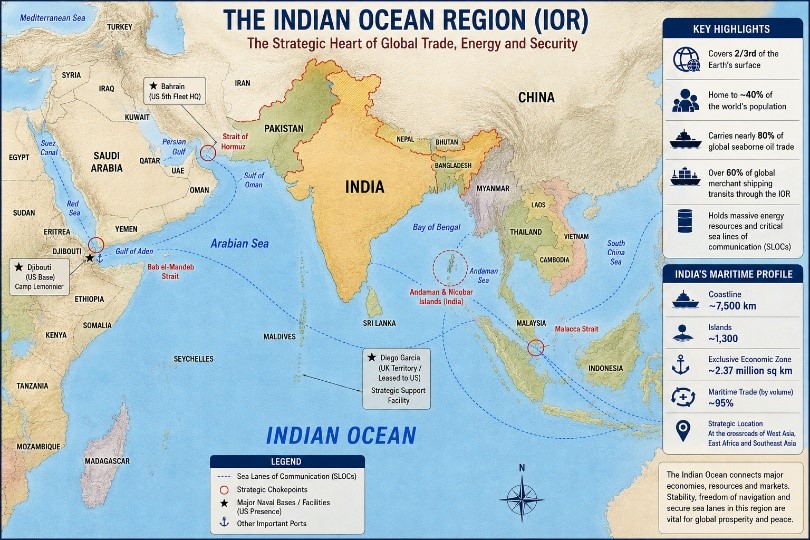
Ironically, even as the United States re-emphasizes the Pacific, its military footprint in the Indian Ocean remains substantial. The U.S. maintains the strategically vital base at Diego Garcia, hosts the U.S. Fifth Fleet headquarters in Bahrain, enjoys extensive military access arrangements across the Gulf, and maintains a permanent presence at Djibouti overlooking the Bab-el-Mandeb Strait. These facilities underscore an enduring reality: control and access in the Indian Ocean remain indispensable to global power projection. If the world's foremost military power attaches such importance to the Indian Ocean, India can scarcely afford to do otherwise.
For India, therefore, the more pertinent question is not why the United States has changed a name, but how India should respond. New Delhi should view this development as an opportunity to reinforce its own maritime identity and strategic responsibilities.
India's maritime geography itself demands such an approach. With a coastline exceeding 7,500 kilometres, over 1,300 islands, an Exclusive Economic Zone of approximately 2.37 million square kilometres and nearly 95 percent of its trade by volume moving through sea routes, India's prosperity and security are inextricably linked to the seas. Furthermore, India's security interests today extend far beyond its immediate coastline—from the Strait of Hormuz in the west to the Malacca Strait in the east.
Against this backdrop, India should consider redesignating the Andaman and Nicobar Command (ANC) as the "Indian Ocean Command". Situated astride the Malacca Strait at the confluence of the Indian and Pacific Oceans, the ANC occupies one of the world's most strategic locations. A renamed and empowered Indian Ocean Command would more accurately reflect India's expanding maritime responsibilities and strategic reach.
The proposal assumes greater relevance as India moves towards integrated theatre commands. Rather than remaining a geographically confined island command, an Indian Ocean Command could evolve into the principal theatre responsible for maritime security across the entire Indian Ocean Region, integrating naval, air and amphibious capabilities under a unified structure.
Equally important, the nomenclature "Indian Ocean Command" carries a broader strategic connotation. It reflects India's centrality to the security architecture of South Asia and the wider Indian Ocean littoral, encompassing the Gulf region, East Africa, island nations and Southeast Asia. Such a command would signal India's willingness to assume the role of a net security provider and principal stabilizing force in the region.
The United States may choose to re-emphasize the Pacific. India, however, must remain firmly focused on the Indian Ocean. Strategic relevance is not conferred by others; it is earned through capability, presence and leadership.
Names may change in Washington, but India's geography remains immutable. The Indian Ocean bears India's name; it is time that India's strategic architecture reflected that reality. An Indian Ocean Command would not merely be a new designation—it would be a declaration of India's maritime ambition and regional leadership..
Col Mohinder Pal Singh, PhD is Director EGROW Foundation. Views expressed are personal.