Indo-Korea Economic Conference
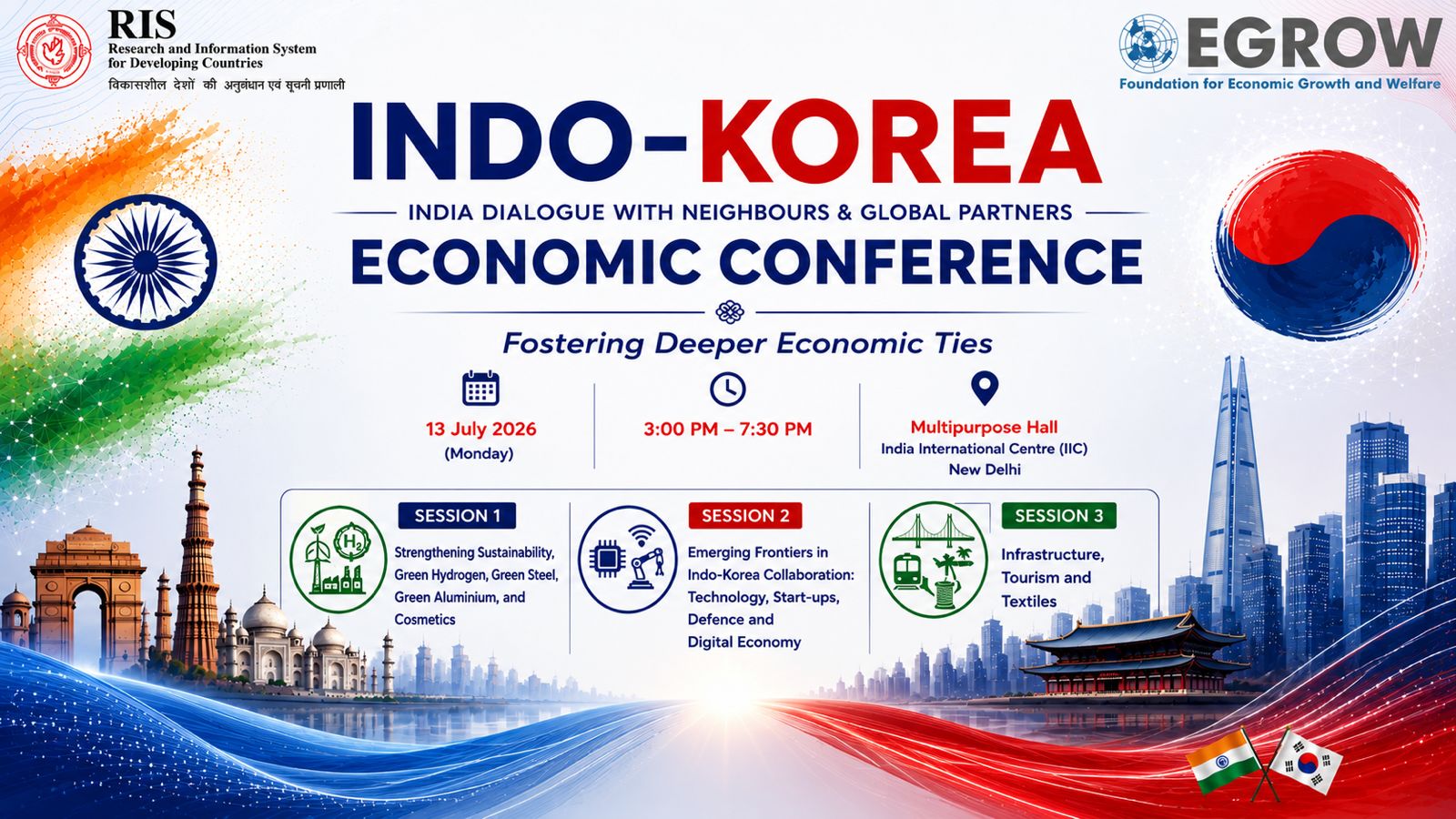
The partnership between India and the Republic of Korea (ROK) operates within a challenging global economic landscape defined by escalating geopolitical frictions, rising protectionism, and the critical imperative for supply chain diversification. Building on diplomatic relations established in 1973 and elevated to a "Special Strategic Partnership" in 2015, the bilateral ties have matured into a robust, multidimensional collaboration spanning economic, political, strategic, technological, and cultural domains.
India–Republic of Korea economic relations continue to be underpinned by robust trade and investment linkages. According to the Directorate General of Commercial Intelligence and Statistics (DGCI&S), Ministry of Commerce and Industry, bilateral merchandise trade reached approximately US$27.37 billion during FY2025–26. India's exports to the Republic of Korea stood at approximately US$6.01 billion, while imports amounted to US$21.35 billion, resulting in a merchandise trade deficit of approximately US$15.34 billion. Although India's exports to the Republic of Korea recorded positive growth during FY2025–26, the merchandise trade deficit remains significant. This highlights the need to diversify exports, deepen value chain integration, strengthen the implementation and review of the Comprehensive Economic Partnership Agreement (CEPA), and promote innovation-driven investment and technology collaboration between the two countries. These priorities call for policy measures that can catalyse innovation-driven investment, facilitate technology transfer, improve market access, and further enhance the ease of doing business for enterprises from both countries.
In response, both governments have prioritized deeper engagement in strategic sectors, including semiconductors, shipbuilding, electric vehicles (EVs) and EV components, renewable energy, and digital finance. Initiatives like the Korea Plus Desk and ongoing negotiations to upgrade the Comprehensive Economic Partnership Agreement (CEPA) underscore the joint commitment to reducing trade imbalances and broadening collaboration. As India and South Korea align their agendas with regional frameworks such as the Indo-Pacific Economic Framework (IPEF) and the Mineral Security Partnership (MSP), their strategic partnership is poised to promote sustainable growth and regional stability.
Beyond these priority areas, both countries are increasingly collaborating in emerging sectors such as green hydrogen, low-carbon manufacturing, green steel and aluminium, circular economy practices, and consumer industries, including cosmetics and wellness products. Opportunities are also expanding in infrastructure development, including railways, ports, smart cities, logistics, and engineering, procurement and construction (EPC) projects, as well as in defence technologies, digital innovation, technical textiles, tourism, and people-to-people exchanges, reflecting the growing breadth of the India–Korea Strategic Partnership. These sectors are expected to play an important role in strengthening industrial competitiveness, enhancing resilient supply chains, and supporting sustainable economic growth in both countries.
This Conference aims to harness this momentum by bringing together policymakers, industry leaders, scholars, diplomats, and business practitioners to deliberate on actionable strategies for strengthening trade, investment, sustainable manufacturing, innovation, infrastructure, tourism, and high-technology collaboration. Particular emphasis will be placed on advancing partnerships in green industries, digital transformation, resilient supply chains, consumer industries, and emerging technologies to build a balanced, resilient, and future-ready India–Korea economic partnership.